Pokémon TCG for Beginners: 7 Simple Steps to a Fun Start
A plain-English starter guide to the trading card game: card types, Prize cards, sealed products, English vs Japanese, regulation marks and card care.
In this guide 10 sections
Whether a child in your family has caught the bug or you are coming back to the hobby after years away, Pokémon cards are easier to get into than the wall of boxes suggests. This guide explains how the trading card game works, what each sealed product actually contains, and how to make sensible first choices without paying for things you don’t need.
Every rule below matches the official rulebook from The Pokémon Company International, so the terms you learn here are the same ones you will hear at a league night, in a store tournament or in the official digital game.
What the Pokémon Trading Card Game is
At its core the Pokémon TCG is a two-player strategy game. Each player brings a deck of exactly 60 cards, takes turns attaching Energy, evolving Pokémon and attacking, and races to take six Prize cards before the opponent does. Games move along quickly once you know the flow of a turn.
It is also a collecting hobby. Every expansion adds new artwork, rarities and chase cards, and plenty of fans never play a single match: they build binders of favourite Pokémon illustrations instead. Both approaches are valid, and many people end up doing a bit of each. Knowing which camp you lean towards makes every buying decision simpler.
The three card types
Every card falls into one of three groups. You can tell them apart by the layout and by the label printed at the top of the card.
- Pokémon cards are the creatures that battle. Basic ones go straight from your hand onto your Bench, while Stage 1 and Stage 2 cards evolve from them and hit harder. Each shows its HP, attacks, type, Weakness and Retreat Cost.
- Trainer cards are your support. Items are played and discarded, Supporters are stronger but limited to one per turn, Stadiums stay in play, and Pokémon Tools attach to one of your Pokémon to help it.
- Energy cards power your attacks. Basic Energy matches your attackers’ types, and Special Energy cards carry extra effects. You may attach one Energy card from your hand each turn.
Some cards carry a rule box that marks them out as big hitters. When a Pokémon ex is Knocked Out, the opponent takes two Prize cards instead of one, and a Mega Evolution Pokémon ex gives up three. That trade-off sits at the heart of deck building: powerful cards end games faster, but they also hand your opponent a shortcut. Our Mega Evolution guide explains how the current era’s three-Prize cards work.
How a game is won
To set up, each player shuffles, draws seven cards, places a Basic face down as their Active card and sets aside the top six cards of the deck, face down, as Prize cards. Each time you Knock Out one of your opponent’s Pokémon, you take a Prize card into your hand (two for a Pokémon ex, three for a Mega Evolution Pokémon ex). The rulebook lists three ways to win:
- Take all six of your Prize cards.
- Knock Out your opponent’s last Pokémon in play, so they have nothing left to battle with.
- Your opponent has no cards left in their deck when they need to draw at the start of their turn.
Turns follow a simple rhythm. Draw a card, then do any of these in any order: play Basic Pokémon to your Bench, evolve, attach one Energy, play Trainers (only one Supporter), retreat once and use Abilities. Finish by attacking, which ends your turn. The player who goes first can’t attack or play a Supporter on that opening turn, and nobody can evolve a Pokémon on its first turn in play.
Sealed products explained
All the boxes on the shelf contain the same booster packs from a given set. What changes is how many packs you get and what comes with them, so it pays to know the main formats before you choose.
Booster packs and Booster Bundles
An English booster pack holds 10 cards plus a Basic Energy. A Booster Bundle groups six packs together with no extras, which makes it a tidy, low-fuss way to open a handful of packs from one set.
Elite Trainer Boxes
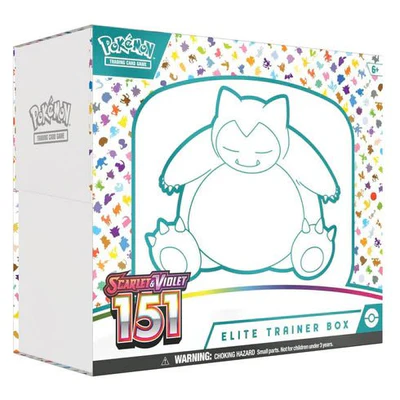
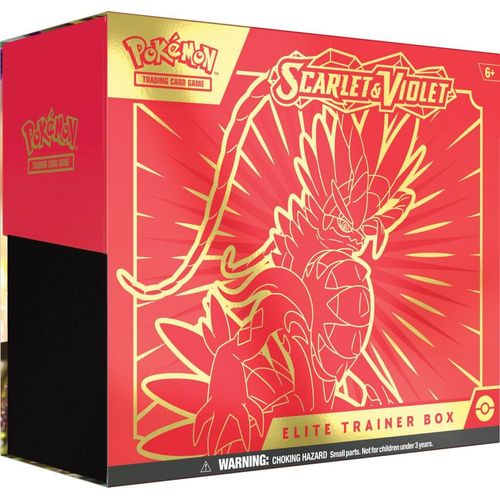
The Elite Trainer Box (ETB) is the classic first purchase. A Scarlet & Violet-era ETB contains nine booster packs, a full-art promo card, 65 card sleeves, 45 Energy cards, a player’s guide, damage-counter dice, a coin-flip die, condition markers and a storage box with dividers. The Scarlet & Violet Elite Trainer Box pictured above includes a full-art Koraidon or Miraidon promo, while newer Mega Evolution-era ETBs come with 40 Energy cards and six dividers.
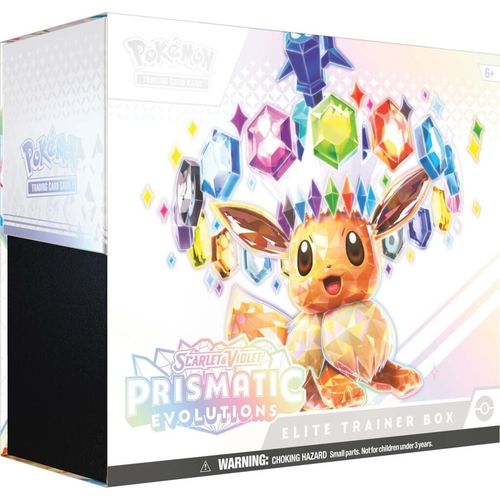
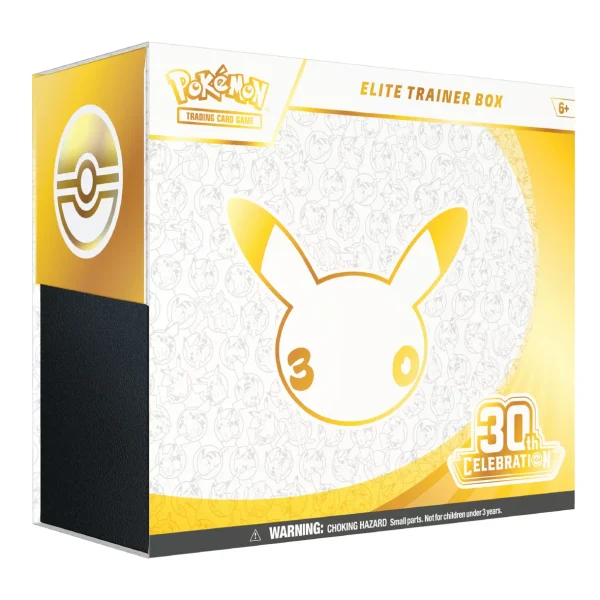
For a newcomer, that kit is the real value: you get everything needed to sleeve and play a deck. The Pokémon 151 Elite Trainer Box suits anyone who grew up with the original Kanto creatures, the Prismatic Evolutions Elite Trainer Box centres on Eevee and its eight Evolutions, and the 30th Celebration Elite Trainer Box launched with its anniversary set on 16 September 2026, with one of 30 different Pikachu cards in every pack.
Booster boxes
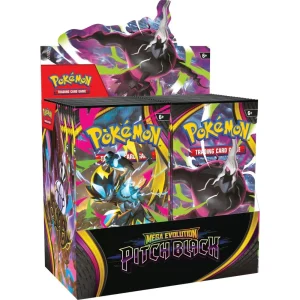
An English booster box holds 36 packs. It is the most efficient way to open lots of one set and is popular for group box breaks or for chasing a complete set. Special sets such as 151 and Prismatic Evolutions skipped the standard English booster box, so check before you go looking. Our guide to choosing a Pokémon booster box covers English, Japanese and special-set options in detail.
Collections and tins
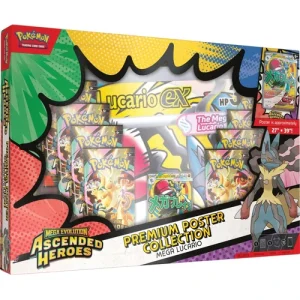
Premium collections, tins and blister packs pair a few packs with promos, figures or playmats. They make lovely gifts, but read the listed contents first: some focus on display pieces rather than the sleeves and dice you need to play.
English or Japanese cards?
Many English sets are adapted from Japanese releases that arrive months earlier. The Japanese Scarlet ex and Violet ex expansions, for example, came out on 20 January 2023 and were combined into the English Scarlet & Violet base set on 31 March 2023. Japanese packs are smaller (the Scarlet ex and Violet ex packs hold five cards each), and many Japanese expansion boxes contain 30 packs.
If you want to play at an English-speaking league or event, stick with English cards so everyone at the table can read the text. Japanese cards appeal to collectors who like getting a set early or enjoy the different packaging. You can read how the current generation of sets began in our guide to Pokémon Scarlet and the card sets it launched.
Standard format and regulation marks
Look at the bottom-left corner of any recent card and you will spot a small letter. That is the regulation mark, and it decides whether the card can be used in the Standard format, the main way the game is played at official events. Rotation usually happens once a year and removes the oldest legal letter.
Since 10 April 2026, Standard has used cards marked H, I, J and later, while G-marked cards rotated out (the digital game switched over on 26 March 2026). Rotated cards are still perfectly fine for casual games and keep their place in your binder. Bulbapedia keeps a clear summary of the 2026–27 Standard format.
Protecting your cards
Sleeve anything you care about the moment it leaves the pack. Standard-size sleeves fit Pokémon cards, and an ETB’s 65 sleeves cover a full 60-card deck with a few spares. For special pulls, many collectors double-sleeve (a snug inner sleeve inside a regular one) or move the card into a rigid top loader.
Store binders upright, keep cards out of direct sunlight and away from humidity, and choose side-loading pages so cards can’t slide out. Skip rubber bands and ring binders that press into cards near the rings, because those dents never come out.
Where to start: 7 simple steps
- Decide whether you mainly want to play, collect, or do both.
- Learn the basics with a ready-made deck or the official digital game, Pokémon TCG Live.
- Pick one set whose artwork you love and focus on it, rather than buying a little of everything.
- Choose an Elite Trainer Box if you want packs plus accessories, or a Booster Bundle if you only want packs.
- Sleeve your favourite cards straight away.
- Check regulation marks before building a deck for official events.
- Find a local league or play group, because experienced players are the best teachers.
Shop the range
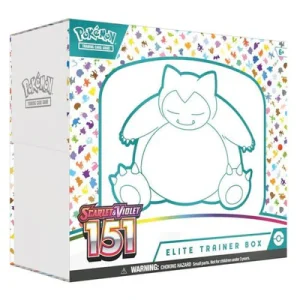 Pokémon 151 Elite Trainer Box
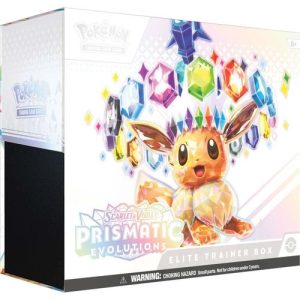 Prismatic Evolutions Elite Trainer Box
 30th Celebration Elite Trainer Box
Each of these Elite Trainer Boxes works as a complete starter kit: packs for the fun of opening, plus sleeves, Energy and dice for your first games. Browse the full Pokémon TCG range when you are ready to branch out, and keep the official rulebook (PDF) handy while you learn.
Beginner FAQs
How many cards are in a Pokémon deck?
Exactly 60. Apart from Basic Energy, you can include no more than four cards with the same name.
How many Prize cards does each player set aside?
Six. You take one each time you Knock Out an opposing Pokémon, two for a Pokémon ex and three for a Mega Evolution Pokémon ex.
What is a good first product for a beginner?
An Elite Trainer Box is the easiest start, because it pairs nine booster packs with sleeves, Energy cards, dice and a storage box.
Can I play with Japanese cards?
At home, yes. For English-speaking leagues and events, English cards are the practical choice so both players can read the text.
What does the letter at the bottom of a card mean?
It is the regulation mark. Since 10 April 2026, cards marked H, I, J and later are legal in the Standard format.